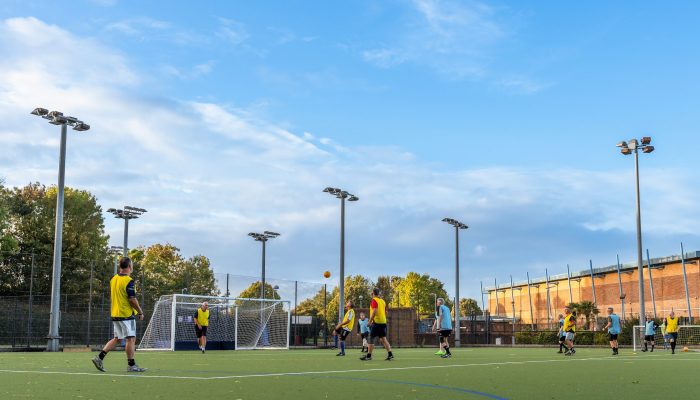

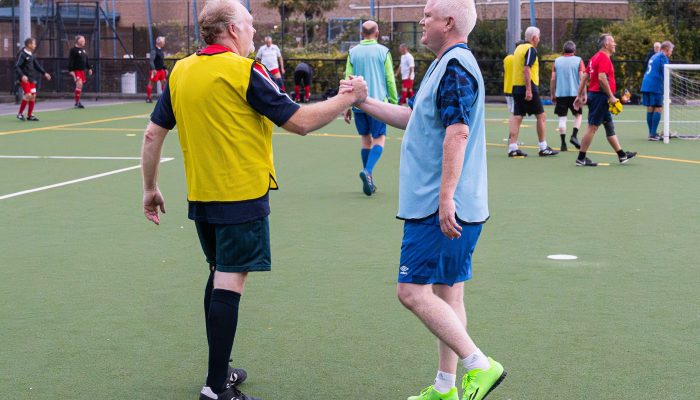
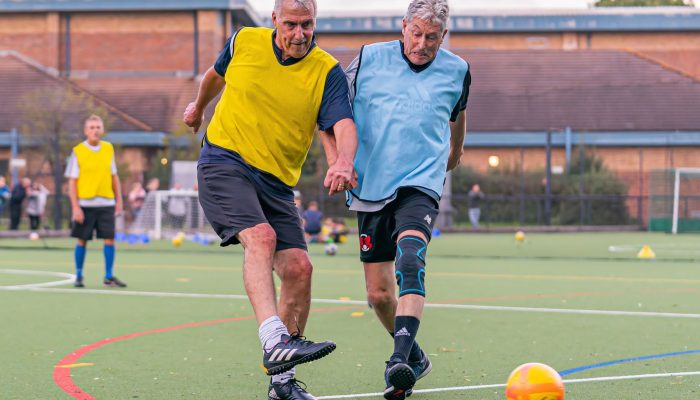
Walking football is a fast-growing, modified version of the beautiful game. It brings the joy of football back to people who thought their playing days may be over, but also offers entry-level access to people who may have played little or no football during their lives.
In 2011 Walking football was conceived as a sport to be played by men over 50 and women over 40s. As a club we have players in their 50s all the way up to several in their 80s.
The game is played on small pitches with small goals and competitive games are normally 6-a-side. it can be played indoors, on 3G or 4G artificial grass pitches or on natural grass.
The rules have been devised in such a way as to allow the game to be played safely by participants in older age groups.
Basic Principles & Core Rules
The game follows standard football rules but with vital changes to ensure safety:
- Strictly no running: Jogging or sprinting results in a free kick to the opposition
- One foot grounded: Players must keep at least one foot on the turf at all times
- Minimal contact: Tackling from behind, pushing, and ‘backing in’ are forbidden
- Head height rule: The ball must stay below head height to prevent aerial collisions
Physical Health Benefits
- Cardiovascular health: Keeps the heart rate up to improve overall aerobic fitness
- Joint friendly: Low-impact movement reduces stress on knees, hips, and ankles
- Weight management: Burns calories and helps maintain a healthy metabolism
- Strength & balance: Builds core muscles, which drastically cuts the risk of falls in daily life
Mental & Social Health Benefits
- Combats isolation: Connects older adults with a vibrant, welcoming team community
- Boosts mood: Releases endorphins that help reduce symptoms of anxiety and depression
- Sharpened focus: Fast-paced passing and tactical thinking keep the mind sharp
- Restored identity: Allows former players to feel like footballers again, boosting self-esteem.
Read the WFA Guide to Playing Walking Football